

What Excites Us!
Episode 69: What You Got Wrong About Non-Monogamy with Ellecia Paine
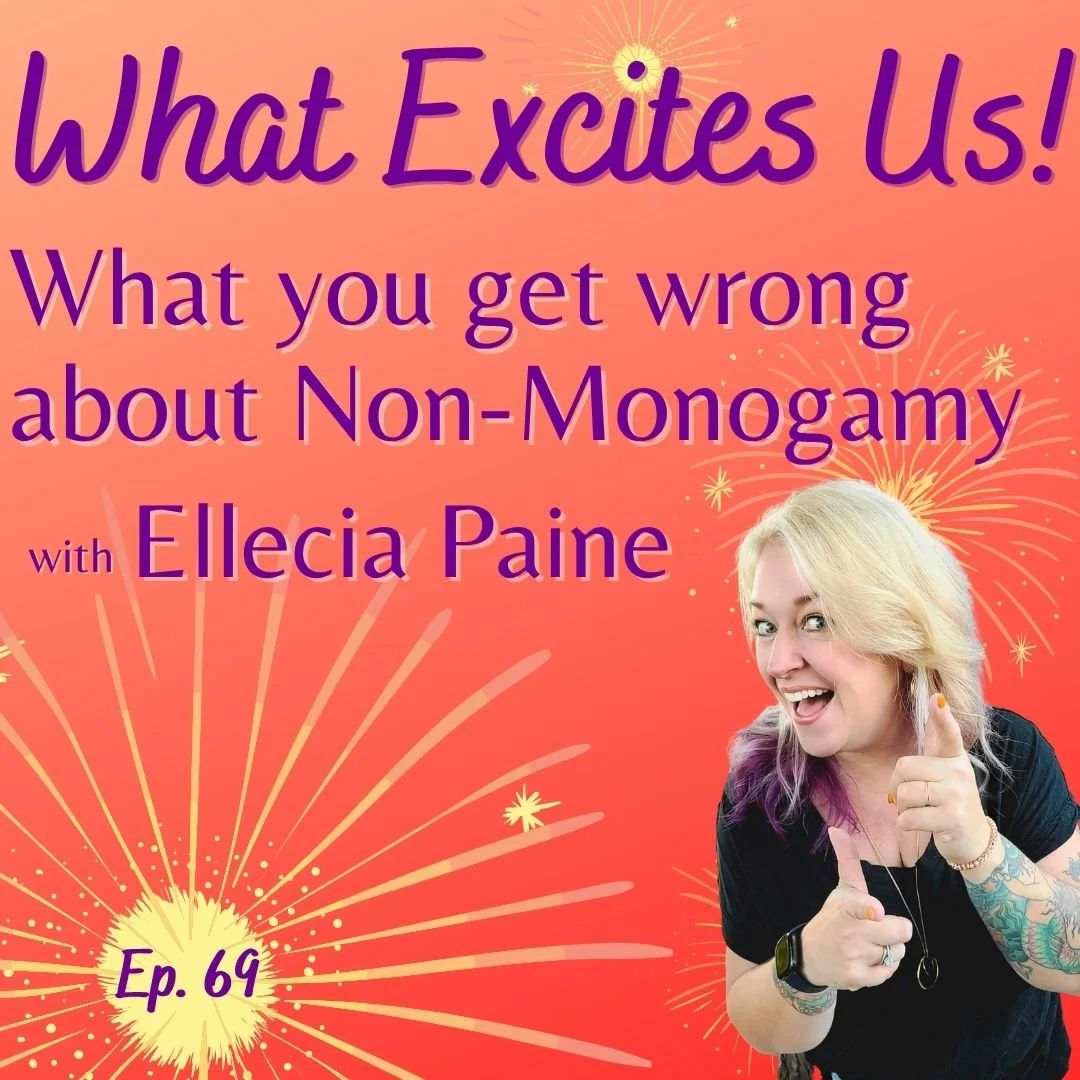
Episode 69: What You Got Wrong About Non-Monogamy with Ellecia Paine
Relationship Coach Ellecia Painehelps adventurous people break the social conditioning of monogamy and learn how to navigate healthy alternative relationship styles such as ethical non-monogamy, open relationships, polyamory and swinging. She helps them move through the challenges like jealousy, fear, anxiety, and insecurities in a way that strengthens their relationships, deepens trust and communication, and leaves them feeling confident.
As the host of the podcast Nope! We're Not Monogamous, Ellecia believes in courageously challenging the status quo and empowering people to create relationships that work for the real people in those relationships. Throughout the past 10 years living in an ethically non-monogamous relationship while working as a sex, love, and relationship coach, Ellecia has acquired valuable insight and a unique ability to share this information with her clients and audience in a way that hits home while leaving them feeling validated and whole.
Visit Ellecia at: ElleciaPaine.com
Instagram: https://www.instagram.com/elleciapaine
Facebook: https://www.facebook.com/elleciapaine
Youtube: https://www.youtube.com/@elleciapaine
Tiktok: https://www.tiktok.com/@elleciapaine
You think jealousy means you're not cut out for non-monogamy. Non-monogamy coach Ellecia Paine is here to change your mind.
Ellecia spent 13 years in a monogamous marriage, came out the other side knowing she never wanted that again, and built a coaching practice and podcast helping people navigate ethical non-monogamy, polyamory, open relationships, and swinging. In this conversation, we get honest about what it actually takes to open a relationship without blowing it up, and why most of the challenges people face aren't what they think they are.
Some Key Takeaways:
The main styles of ethical non-monogamy and what actually sets them apart
Why jealousy isn't a disqualifier... it's just an emotion that needs tools
How shame was designed to keep us small (and how to start moving through it)
The confidence and self-worth stuff that surfaces the moment you open a relationship
Baby steps for anyone curious about non-monogamy but not sure where to start
Why knowing yourself intimately (yes, that kind of intimately) is the foundation of everything
Get your shopping on!
Using these links helps to support WEU!
In this episode we mentioned:
The Ethical Slut by Janet Hardy and Dossie Easton
They now have a Workbook too!
Momotaro Apotheca For all Your Vulva Care needs and wants - use the link or code GWYN20 for 20% off
Agreeable Agony - Makers of Fine Kinky Play Items - use the link or code SEXFAIRYGWYN for 5% off - please support this lovely small business!
überlube- Only the best High Performance, body friendly Silicone Lube available! Recommended by medical professionals, sexologists and many households. Get yours here.
Toendi - Adult Toys by a manufacturer that cares! Use this link or code for 10% off your order!
Or code gwyn0122
Transcript:
[00:00:00] Gwyn: This podcast is about sex and sexuality, so please only listen if you are an adult without kids or other ears around that cannot, or do not consent to sensitive language and content. Thanks.
[00:00:20] Hello and welcome to What Excites us. My name is Gwyn Isaacs. I am a clinical certified sexologist who's been helping folks with a variety of concerns since 2017. This episode is a replay from one of the sessions I had during my Reclaiming You Summit in September. If that's something that interests you, there will be another one coming up, I'm not exactly sure when, so you should be sure to be on the mailing list so you can find out more.
[00:00:52] This conversation, however, is amazing. It is with Ellecia Payne, your non-monogamy coach. And we talk about a whole bunch of things, including what you won't know, you don't know, and how to deal with jealousy, what confidence really looks like, opening up a relationship, how that can go, good or bad.
[00:01:15] Just a whole bunch of fantastic topics that we touch on. So please stay tuned. Listen to this wonderful recording. And go to whatexcitesus.com to be sure you are getting the newsletter for everything that happens in my world.
[00:01:34] Relationship coach Ellecia Paine helps adventurous people break the social conditioning of monogamy and learn how to navigate healthy alternative relationship styles such as ethical, non-monogamy, open relationships, polyamory and swinging. She helps them move through challenges like jealousy, fear, anxiety, and insecurities in a way that strengthens their relationships. Deepens trust and communication and leaves them feeling confident. As the host of the podcast, Nope, We're Not Monogamous, Ellecia believes in courageously challenging the status quo and empowering people to create relationships that work for the real people in those relationships. Throughout the past 10 years, living in an ethically non monogamous relationship while working as a sex, love and relationship coach, Ellecia has acquired valuable insight and unique ability to share this information with her clients and audience in a way that hits home while leaving them feeling validated and whole. Thank you so much, Ellecia, for coming on to the Reclaiming You Summit. I am so excited to have this conversation with you.
[00:02:47] Ellecia: Yeah. Thank you for inviting me. This is, this is gonna be fun.
[00:02:52] Gwyn: let's just start with. How did you decide that non-monogamy was a thing that was gonna work for you?
[00:03:00] Ellecia: Mm. I love that question. Well, I was married, non monogamously. Nope. I was married, monogamously for 13 years. And when that relationship ended, I was like, okay, I am 35. I have a couple of kids, I have a house, I have a business. I don't ever wanna get married again. As a matter of fact, I don't ever wanna be monogamous again.
[00:03:25] I didn't, I didn't know anybody else who was non-monogamous, so it wasn't like I was seeing what other people were doing. I, I just was like, Hmm, I don't think I want that for myself. And my joke was, I never wanna be tied down again. Figuratively and I also knew that I had all my life been a pretty jealous and possessive person in my relationships.
[00:03:50] And so I knew that that was something I would need to figure out. And I thought, well, I guess I'll just, I'll just be a little slutty, but I'll be honest about it because that seems like the right thing to do. And then I started meeting people who were polyamorous and non-monogamous and swinging and all sorts of varieties of non-monogamy and learning more and more about it and have not looked back.
[00:04:17] Gwyn: Excellent. That's amazing. Like you just, like a hit on the head was like, Nope. Done with that next
[00:04:25] Ellecia: Yeah.
[00:04:26] Gwyn: That's amazing.
[00:04:28] Ellecia: Yeah. I, you know, I, I had realized how many things in my life I wanted, but didn't go for because of my partner. Because I was in love and didn't wanna lose a relationship, so I didn't go and do the things I wanted which created a lot of regret. And so I just didn't wanna do that again.
[00:04:48] Gwyn: Boy that hits. Yeah.
[00:04:51] Ellecia: Yeah.
[00:04:52] Gwyn: Yeah. There's a lot of that. in a lot of different styles of relationships, like even in friendships, sometimes we find
[00:05:00] Ellecia: So,
[00:05:01] Gwyn: not doing something because we're concerned what the other person or doesn't think or wants to do or doesn't want to do. And a lot of times we don't even communicate that. And then so we could be just imagining things.
[00:05:16] Ellecia: yeah. Yeah.
[00:05:18] Gwyn: Before we go any deeper into that, because that's a whole thing, let's back up a little bit and can you break out those different non-monogamy styles? Okay.
[00:05:29] Ellecia: Yeah. Yeah, absolutely. So ethical non-monogamy or consensual non-monogamy is kind of an umbrella term for not being monogamous and being open and honest about it. You know, and then under that umbrella you have lots of things that, that people may have heard of. Polyamory is having many loves or the ability to love many people.
[00:05:48] Swinging is typically, uh, maybe couple swapping or, or kind of non, non-emotional, more play for fun, uh, sexy times. Open relationships, or kind of, kind of a similar thing there. Relationship anarchy is the idea that the structure of the relationship isn't what's important, but letting each relationship develop as it, can in may. Those are kind of the main ones.
[00:06:18] Gwyn: Yeah. Yeah, that makes sense.
[00:06:20] Ellecia: There's so many other, other terms that people use. Like I could go on and on all day.
[00:06:25] Gwyn: Right, right. And the difference between this kind of poly and that kind of poly and
[00:06:30] Ellecia: Yeah.
[00:06:31] Gwyn: But I, I don't think that's
[00:06:32] Ellecia: I,
[00:06:32] Gwyn: at right now. For that though, folks should tune into your podcast to go
[00:06:36] Ellecia: yeah. Yeah.
[00:06:39] Gwyn: We're gonna stay pretty, pretty surface in this one, although. Not too certain.
[00:06:44] You know, we're not gonna go deep. Let's just put it that way. That doesn't sound right either. I can
[00:06:50] Ellecia: So deep
[00:06:51] Gwyn: in my head going phrasing
[00:06:53] Ellecia: Uhhuh.
[00:06:54] Gwyn: Lana. Turning back to you a little bit, you had that realization that you didn't wanna do that. How did you start investigating what the possibilities were? You said you didn't know folks, so how did you even know that was an option?
[00:07:14] Ellecia: I didn't, besides from just like dating, you know, in a traditional dating where I, I was like, I don't see the difference besides you know, like people will just date, but they'll date one person at a time until they. Until they kind of select out, okay, that's not the one, so now I'm gonna date someone else.
[00:07:38] Okay, that's not the one, and now I'm gonna date someone else. And that's, you know, and I was like, that sounds exhausting. But the first thing I did actually is I read The Ethical Slut. And that book really kind of opened my eyes to all the different ways that one can be an ethical slut, but also. Just to different belief systems besides what we are taught growing up.
[00:08:02] So I started there and at that same time I was also starting, I was going to school to become a coach, and I was in Layla Martin's program. Um, and I thought I was gonna be a women's sexual empowerment coach. That's, that's what I was going to school to study. But as I went through the next two years of, of, of, um, studying and, and getting that certificate.
[00:08:23] I realized all I was talking about was relationships and non-monogamy. I was like, Ooh, this is kind of a passion of mine.
[00:08:28] Gwyn: I love that. Yeah. You just, and so to extrapolate looking around to see what it is that you talk about, what whoever you are that, what the things that are coming out of your mouth that you're reading, that you're interested in, that you are focusing on,
[00:08:44] Ellecia: Yeah.
[00:08:45] Gwyn: a, I think a starting place that a lot of folks might not. Recognize.
[00:08:52] Ellecia: Mm-hmm. Mm-hmm. Truly, truly, I think we all have these kind of, these, these internal drives, these directions that we want to go and then we go, oh wait, what will people think? Or what should I do? What what is the right? Quote, unquote, the right thing to do. And often that answer is not the same as what we really want to do or really have a deep desire for.
[00:09:18] Gwyn: Yeah. And so that desire and recognizing that desire is really a step towards understanding who you are, which is a step towards confidence.
[00:09:29] Ellecia: Yeah, a hundred percent.
[00:09:33] Gwyn: How can you specifically, Ellecia, how can you help people do that? what, what are some of the ways that you work with people along those lines?
[00:09:45] Ellecia: Yeah, absolutely. So a lot of times people will come to me going I wanna open my relationship or my partner when to open our relationship, but I don't know. Or we've, we, we jumped in the deep end, we opened up and now we're floundering and, and I don't know what I want. I thought I wanted to have a bunch of sex, but now I'm scared I'm gonna lose my relationship.
[00:10:05] Or I wanted to have a bunch of love, but now, now my partner wants a bunch of sex. You know, like, like there's a lot of, I, I just don't know. Am I doing everything wrong? And the first thing I always tell people is, we gotta get some clarity, right? We gotta get really clear on like, what, what is the desire?
[00:10:21] Why, what will that do for you? Uh, what is your like North Star? The guiding light that's. That makes it worth going through hard work to, to come out the other side. And really digging in and going like, what is the desire? Right? If the desire is more sex, well, why? What, what is it about that, what does that give you?
[00:10:38] What does that feed? If the desire is more connections, more relationships, what will that do for you? What will change in your life? What are you hoping will be different or what are you hoping the, the outcome on the other side of that is? And it's often not what people think.
[00:10:54] Gwyn: Yeah. Yeah, absolutely. So it sounds like you're, you're helping reframe some of their questions.
[00:11:06] Ellecia: yeah. Absolutely.
[00:11:08] Gwyn: So what are, what are some of the
[00:11:10] Ellecia: Absolutely.
[00:11:10] Gwyn: that come up when that happens on your client end?
[00:11:14] Ellecia: I think a lot of people are surprised to find that, oh gosh, there's so many different scenarios, but a lot of times what they think the issue is, like the challenge that they're bumping up against is. Is often not even actually what the challenge is, right? It might be like, Hey, we have different libidos.
[00:11:34] One of us wants more sex and the other one doesn't. And so we opened up so that you can go, go do your thing, right? And it turns out that like that's not actually what they wanted. They just wanted like deep connection and thought that sex was the only way to get that. Or. They, they think that they are, I'm being so clear about what I want and what I, what my desires are, what my boundaries are.
[00:11:56] And then it turns out that actually the words I'm using are not hitting home for my partner. And we think we're saying the same thing, but we keep fighting because like, we're not actually, we don't mean the same thing when we use the same words, right? Like lots of communication issues there. What else? Oh, and then the other, the biggest one I think is a confidence thing. Human beings are just really bad at guessing how we're gonna feel about an imagined scenario, right? We, we throw out all these hypotheticals, like, yeah, I'm totally fine with that. And then we see our partner put their hand on someone's knee and the next thing you know, the floor is falling out from under you and you're like, oh my God, I'm gonna die and get divorced.
[00:12:36] I don't know what to do. That's not what I thought would happen. Clearly something is wrong. So much of the challenges that people run into come back to confidence and self-worth. What if nobody chooses me? Or what if my partner, uh, leaves me for someone else? Or what if I leave my partner for someone else?
[00:12:54] What if I fall in love with someone better? Right? Like, so much of it comes down to how do I feel about myself? And we run into our insecurities in ways that don't get confronted Often in monogamous relationships and we're like, oh, I thought I was totally good. I thought I was totally confident, and now I'm being faced with competition, right? I'm being faced with somebody who has something that I feel insecure about. That's probably the biggest one.
[00:13:23] Gwyn: Yeah, I could totally see that. and a very personal perspective, I've never been monogamous in my entire life. Like back in the eighties we called it an open relationship,
[00:13:34] Ellecia: Yeah.
[00:13:34] Gwyn: which is fine. And I've had some partners that were great with that and some that were, mm, wish they hadn't done that.
[00:13:39] And that's. Totally okay. And still today, literally today, was hanging out with someone who is an ex who has a new playmate. And I found myself being like snippy and we're shocked by that. Like, what is that about? Like I, and this person and I are ne haven't been seeing each other for years and years and years.
[00:14:05] We're just really good friends and fascinating and being comfortable like, okay, that's interesting. I'm going to look at that and think about that and wonder about that. Doesn't have to mean much. It might mean something that I'm not looking at. I haven't really thought about it yet, but throw it out there that it's okay.
[00:14:25] Ellecia: Yeah. And we we're kind of taught that if you have a feeling like that, you have to jump on it. You have to do something about it or, or that it means something is wrong, someone harmed you, or, oh my God, I'm still in love with him. Like when really most of things our nervous systems respond to is the past.
[00:14:45] It kind of treats everything that's happened in the past. It, as it associates the current right now, what we're doing as though it were then,
[00:14:51] Gwyn: Yeah, and it doesn't have to be urgent,
[00:14:54] Ellecia: yeah, take time.
[00:14:56] Gwyn: have to mean everything
[00:14:58] Ellecia: yeah.
[00:14:59] Speaker 8: Fun fact, the first vlogger my honey and I bought together was a beautiful handmade leather piece by a nice small local company called Agreeable Agony. Over a decade later, it is still my favorite toy, and I'm happy to say that they're still around making toys and have grown to have an online website, so you don't have to go to an event to buy them.
[00:15:23] You can purchase discreetly from your home. And I'm even more excited to tell you that if you use my code Sex Fairy Gwen, or go through the link on my webpage whatexcitesus.com, you can get 5% off your entire purchase. So go visit Agreeable agony today they have implement toys, wax books, rope. Things that you can learn from, things that you can play with, and all of it is super fun.
[00:15:52] So go visit agreeable agony.com today and be sure to tell them Sex Fairy Gwyn sent you.
[00:15:59] Gwyn: So. Since you help folks with that and, and reconnecting with their own sense of pleasure and desire and honesty and, and figuring out what that means for them. I bet shame comes up a lot.
[00:16:14] Ellecia: Uhhuh. Yeah. Yeah. I mean, you know, I don't, I don't think we can get away from, from shame. In most areas of our lives, but especially when we're talking about love and sex. There's, there's so much. Uh, we're taught that, and we're all a little bit different, that there's a right way to do things and pretty much every way that we're doing them is the wrong way.
[00:16:45] I know very few people who are actually really desire and feel comfortable and fulfilled and happy in doing things the right way, um, because it's kind of a, an unachievable fairytale.
[00:16:57] Gwyn: Yeah.
[00:16:58] Ellecia: Yeah.
[00:16:58] Gwyn: find people that they're being greedy for having desire?
[00:17:04] Ellecia: Being greedy. Yeah. Yeah. Which is wild to me. I think that we have, we have these innate desires. We have things that, that we want to do and feel and experience and say and, and connect with people. And our desires are there to guide us. They aren't, inherently, like bad or wrong, they're there to guide us in the direction of what will fulfill us, what will help us live lives that feel really good and juicy and fulfilling.
[00:17:36] But we've, we've kind of been taught that, especially if you are someone who is raised as a little girl, we've been taught through our patriarchal system that your job, your entire purpose is to serve, to be desireless. To not be greedy at all, to give all of yourself and to suffer in silence. That's the only way you can be a good girl is to serve.
[00:17:59] But that's not ful. There can be some fulfillment in there. Sure. But not if you're just abandoning yourself and giving up all of yourself. It's not fulfilling. It creates a lot of resentment. And when you get to the end of your life, you're gonna look back and go, wow, I, I gave so much. I, uh, recently read something about how.
[00:18:18] Most men at their, their funerals, everyone talks about the things that they achieved in their lives and, and the, the children that they left, the families they left, and what they achieved and did, and the women, everybody talked about how well they treated the people they left behind. She did so much for me.
[00:18:37] She made me feel so good. But nobody talks about their, the women's achievements and the mark that they left on the world besides. She did everything for me. and that doesn't feel, I mean, that's not what I want said about me. I want people to love me because of who I am and not because of what I've done for them.
[00:18:58] Uh, and I, I think one of the main ways to do that is to follow your desires, at the very least. Speak up about your desires and see, see what's available. Because that's, that, that's your desire shows you where, where the juice is for you. And shame is just silly.
[00:19:18] I'm sure it has a purpose through, through evolution of like keeping us part connected to our communities. There's a reason that the emotion exists. But, um, our culture has, has used it to create a whole bunch of, uh, servants.
[00:19:35] Gwyn: Yeah. My theory on that is that back when we were still, you know, pre-history, literally up until a couple hundred years ago, depending on where you were, that that shame would help, keep you alive. Because if you were
[00:19:50] Ellecia: Yeah.
[00:19:51] Gwyn: out, you could be eaten literally by tigers. Whereas in the
[00:19:55] Ellecia: Yeah,
[00:19:55] Gwyn: you had more safety. But that is not the case anymore unless you live in, you know, a, a very select amount of places. There are no tigers coming for us.
[00:20:08] Ellecia: yeah, yeah.
[00:20:09] Gwyn: Probably
[00:20:10] Ellecia: say our brains are still living in caves.
[00:20:13] Gwyn: Mm-hmm. Yeah. Yeah. And so that, that piece of the, that shame piece that is such a strong motivator, as you said, especially for people socialized to be women like, thank you for helping, but you can move along now.
[00:20:32] Ellecia: Yeah, yeah,
[00:20:33] Gwyn: not, you are no longer wanted or needed. Please, please go somewhere else.
[00:20:38] Ellecia: Totally.
[00:20:39] Speaker: I just need to hop on and interrupt this conversation for a moment to say that I've updated my thinking on shame a bit. It is absolutely always a protection mechanism, but it's not only relegated to usefulness in the past.
[00:20:56] If you've grown up in a super restrictive household or an abusive household, shame kept you safe, and that was very, very useful. But now hopefully you have moved on and are not in that situation, and you can thank it for its help and let it go. I understand it's not as easy as it sounds. But recognizing that that is a possibility is a really good start.
[00:21:25] Gwyn: Can you suggest something that folks can do when they notice that coming up to help move through it, like a tangible sort of exercise of sorts?
[00:21:36] Ellecia: Yeah. Yeah. Shame likes to live in the dark. It likes it, it thrives when it's hidden. When we, when we push it down, it really thrives and it sticks around. So, um, when we speak up, I'm feeling embarrassed. I'm feeling ashamed. I'm feeling. Like, I'm wrong and speak up about it. It loses all of its energy, it loses all, all of its power over you.
[00:22:01] And that can feel really terrifying to do so. The first thing I, I always suggest is to, to regulate your nervous system with like, really simply, with just like slow breathing, noticing the room around you, noticing what you can touch, what you can smell, what you can see, what you can taste, because that tells your nervous system.
[00:22:21] Oh, okay. I'm not being chased by a tiger or a lion. Uh, I'm just feeling a little shame. So you regulate your nervous system a little bit and go, Hey, I'm, I'm feeling this thing to whoever. Right. To whoever it is. Even if it's just to the, to the room. Just speaking it out loud makes such a huge difference. Or writing it down, even just getting it out of your head so it's not spiraling.
[00:22:44] Gwyn: Yeah, that makes a lot of sense and,
[00:22:47] Ellecia: Yeah.
[00:22:48] Gwyn: is relatively simple, but not always easy. I just wanna. Make
[00:22:54] Ellecia: Yeah.
[00:22:55] Gwyn: knows that, that it's okay if this doesn't feel easy because sometimes it's really, really not. when it's something that's really deep. And when you start talking about what, what we're talking about with confidence and with pleasure and with creating intimacy, those shame pieces can be so deep
[00:23:15] Ellecia: Yeah. Yeah. I always tell people practice it with smaller things, right? Don't wait until you have a big thing, like, like practice it regularly. You know, regularly do some things to regulate your nervous system, right? You get, you hit your brakes too hard at the red light, and that's a little bit embarrassing.
[00:23:37] Take a few deep breaths and go, oh wow. I feel a little embarrassed that I slammed on the brakes so hard. Right, like little tiny things because it gets easier and easier to do.
[00:23:46] Gwyn: Great advice. Yeah, I love that. I absolutely love that. Okay so now we're, I'm imagining that I I'm Susan and I live in Kansas, and I'm like, oh, okay. I, I'm feeling these things and I feel like I'm ready to start exploring non-monogamy in some ways. What would you suggest as a starting place?
[00:24:09] Ellecia: I would suggest little tiny baby steps. A lot of people kinda think of it as like a light switch. Either I'm monogamous or I'm non monogamous and they imagine non-monogamous to be, and now I'm going to go and do sex things with people. But there's so many other steps between here and there that will save you so much heartache, right?
[00:24:33] Like having, having conversations about it. What is it like to go out and flirt with someone that isn't my partner and then come back and talk to my partner about it? What is it like to go on a date where there's no physical intimacy and then come back and talk to my partner about it, right? Like, like all the little baby steps and go, okay, what worked? What didn't work? What felt good? What felt bad? Just so, so many conversations to have around it.
[00:25:00] Gwyn: Yeah, and going back to what you said earlier with the why I think is really important too.
[00:25:07] Ellecia: And, and the why can change, right? Like we have, we have the, we go, I think this is what I want, and then we go and have that experience. Right. I think I wanna go down that slide and then we go down the slide and we're like, oh my God, it's hot from the sun. I never wanna go down that slide in the sun again.
[00:25:25] I'm gonna change this. I wanna go down the slide with pants on or at night, right? Like, like the thing we want can change. Too often people go, well, but I, this is what I said I want, so I have to stick with it. You get to change your mind. You always get to change your mind. You get to do something different.
[00:25:41] Gwyn: That is such an important piece. Thank you for, for bringing that up.
[00:25:47] Ellecia: Yeah.
[00:25:48] Gwyn: especially as people born with uterus. don't know about you, Ellecia, but I am frequently changing my mind mid thing. like, oh no, this slide is hot off. Gimme off. Gimme off.
[00:26:02] Ellecia: Uh huh. Yeah, this sounded great. I don't want it anymore.
[00:26:08] Gwyn: Done now. Thanks. This was lovely. Gotta go by. Yeah. Yeah. And, and, and then to pull that back into the shame piece and the confidence piece, it doesn't mean that you're not a confident person or that you're a bad person or that you don't want pleasure or that any of those things that those of us that are on the neuro spicy or anxiety spectrum can have.
[00:26:32] Ellecia: Yeah. Yeah, absolutely.
[00:26:36] Gwyn: Yeah, catastrophizing that, that was the word that I was looking for.
[00:26:41] Ellecia: yes. Yeah, my mom has my whole life always said, and I love this, I used to think it was really silly, and now I'm like, oh, she's really wise. She always said, who's gonna care in a hundred years? I'm like, mom, it doesn't matter. I'm not talking about a hundred years from now. And she's like, okay, who's gonna care next year? Oh shit. Probably no one.
[00:27:03] Gwyn: Right.
[00:27:04] Ellecia: Yeah,
[00:27:05] Gwyn: yeah, yeah. That's something I'm frequently telling my children
[00:27:09] Ellecia: yeah,
[00:27:10] Gwyn: that you don't, you don't get to. There's no point where you win. There's
[00:27:14] Ellecia: yeah. Exactly.
[00:27:17] Gwyn: they're biologically like, you know, supposed to fit in, but then they, then that starts to ease off and they're like, why haven't I figured it out? I'm like, you're 20. What?
[00:27:29] Ellecia: Yeah. Yeah.
[00:27:31] Gwyn: It's okay. Things take time and practice and it's okay.
[00:27:36] Ellecia: Mm-hmm. Mm-hmm. Truly.
[00:27:40] Gwyn: And, and especially pulling it back in, this is not about me or my kids or my life, but about Susan in the Midwest somewhere. Figuring out what it is that she likes. It's okay
[00:27:52] Ellecia: Mm-hmm. Yeah. Yeah, yeah, yeah. Exactly. But you gotta start asking yourself, right? Because if you don't start questioning it, you're never gonna get to the answer.
[00:28:05] Gwyn: Right.
[00:28:08] Ellecia: Yeah.
[00:28:09] Gwyn: And, and, and it's, it's those questions, experiments practice pieces, right, that help us figure out what style of relationship works for us.
[00:28:22] Ellecia: Mm-hmm. Yeah. Yeah.
[00:28:26] Gwyn: So I, I also imagine that in your coaching practice, intimacy comes up a fair amount.
[00:28:33] Ellecia: Oh yeah.
[00:28:34] Gwyn: there's so many questions around this. First of all, I absolutely hate the fact that now we have to use intimacy as a, like a synonym for sex, because that's not true at all. You can have intimate sex, you can also have very un intimate sex
[00:28:50] Ellecia: Yes.
[00:28:51] Gwyn: and you can have intimacy with friends and other like just partners that you have no sexual relationship with.
[00:28:59] Ellecia: Mm-hmm. Mm-hmm.
[00:29:03] Gwyn: So how do you help your folks figure those pieces out? I mean, if somebody comes to you and is like, okay, I wanna be polyamorous because I want more in intimacy in my life,
[00:29:16] Ellecia: Mm-hmm.
[00:29:18] Gwyn: I'm not sure that actually means. How
[00:29:24] Ellecia: Yeah.
[00:29:24] Gwyn: this?
[00:29:25] Ellecia: Yeah, yeah, yeah. Yeah. Lots of questions. So many questions, right? Like, what feels intimate to you? What do you wanna get out of that? Is it, when you say intimacy, is it, I want to hug and hold hands with lots of people? Is it, I wanna get railed by 27 dudes? Is it like, right, like what is intimacy?
[00:29:46] Is it something in between there? Uh, what are the fears that come along with those desires? How can we address those fears, right? Is it fears of sex? Is it sexual safety and STIs? Okay. How can we get educated on, all the ways to keep yourself safe, the conversations to have?
[00:30:04] Is it fears of being emotionally intimate and potentially getting hurt? Then how can we boost your your sense of security and self in that, regardless of what other people do, you still know that you are lovable and worthy. Is it. A fear of feeling ashamed, right? Like, like just so what are the desires? What do you wanna get out of it? What are the fears that come up around it? So we can actually work with those and actually address them instead of waiting until the what if happens? Uh, 'cause we love to be prepared. And then also really knowing that like.
[00:30:43] You won't think of all the what ifs, and that's totally fine. You're gonna have experiences that you didn't anticipate that. And some of them are gonna be really amazing and some of them might not be. But staying, kinda staying in the safe zone where there's no ups and downs, there's no risk, there's no reward.
[00:31:04] It, it. For most people probably that are listening to this, they're probably tired of staying in that safe zone where there is no risk and reward. We, we want to feel all the good things and just finding the ways to slowly ex and, and bit by bit experience, will give you more information to make the next choices on.
[00:31:28] Gwyn: Yeah. I love that. That's really, that's really great.
[00:31:32] Ellecia: Oh, and also go make love to yourself. Okay. If you don't know what you want intimately, start playing with yourself. Go masturbate about it. Figure out what turns you on. Figure out what turns you off. What kind of touch do you like? What kind of scents do you like? What kind of music do you like playing that makes you feel turned on?
[00:31:52] Like what environment do you prefer? Is it long? Is it slow? Is it rough, hard, hot, cold? Like what do you really like? Start experimenting with yourself so that you know yourself intimately and can ask partners for that.
[00:32:05] Gwyn: Oh, that's juicy. Yeah. Yes. Yeah.
[00:32:09] Ellecia: Yeah.
[00:32:10] Gwyn: Well, you have a workshop that you are gifting to folks who are listening to this. Tell us about that.
[00:32:16] Ellecia: Yeah, yeah, yeah, yeah. It's, um, breaking outta the monogamous box for thriving non-monogamous relationships. And, um, it's like a hour, hour and a half, and you can, um, go to my website, Ellecia payne.com/breaking out. Um, and, uh, you can just immediately watch that video.
[00:32:36] And in there, what I really talk about is the ways that we've been conditioned in a monogamous culture that still sneak in to non monogamous relationships. For example, even though I knew from the very beginning, I did not want to be monogamous, I met my second husband very quickly and we've never been monogamous together.
[00:32:57] And man, did I struggle with jealousy so hard and he kept asking me like, do we could just close this? And I was like, no. Like I don't wanna be monogamous. I see the reward at the end of the tunnel and my nervous system is responding to all the things I've been told my whole life about relationships and love and sex, and I want to work through this.
[00:33:19] And so, so I really talk about some of those, those ways that are monogamous conditioning and culture. The, the ghost of monogamy is still going to influence relationships even when you make the logical, conscious decision to open up and, and lots of tools and, and whatnot in there.
[00:33:37] Gwyn: Oh, that's great.
[00:33:39] Ellecia: Yeah. Thank you.
[00:33:41] Gwyn: Oh yeah. And I love that you are so open about the fact that you experienced a lot of jealousy
[00:33:48] Ellecia: Mm-hmm.
[00:33:49] Gwyn: and have done work to get that.
[00:33:53] Ellecia: Mm-hmm. Yeah,
[00:33:56] Gwyn: that's a big stopping block for a lot of people. They're like, no, I'm too jealous.
[00:34:00] Ellecia: yeah, yeah. But it's just an emotion. We just don't have a lot of experience with dealing with that emotion. Right? Like if you were like, oh, I can't be in a relationship because I'm too angry. People would be like, well, you need to go to anger management. Like, that's a thing you should work on. Uh, but we don't do that with jealousy for some reason.
[00:34:22] Like I'm, if I'm feeling too jealous, I need tools and the opportunities to, to learn how to manage it, uh, and to learn how to regulate my nervous system and, and have decent, nice, kind conversations with the people that I love.
[00:34:39] It just takes practice and the right tools.
[00:34:41] Gwyn: Right,
[00:34:42] Ellecia: Yeah,
[00:34:42] Gwyn: we don't even, I mean, there are entire cultures that don't, allow that possibility. Even
[00:34:48] Ellecia: yeah, yeah,
[00:34:50] Gwyn: cultures where like jealousy is seen as a good thing,
[00:34:53] Ellecia: yeah,
[00:34:53] Gwyn: which okay, fine, but if that doesn't actually work for you, there are alternatives.
[00:35:00] Ellecia: yeah.
[00:35:01] Gwyn: Oh, this has been great. This has really, really, really good.
[00:35:04] Ellecia: Thank you.
[00:35:05] Gwyn: to chat with you, and I hope everybody goes and watches your workshop and tunes into your podcast because you clearly have so much to share and really great tools and information around this topic. Thank you, Ellecia.
[00:35:21] Ellecia: Thank you so much for having me. This is great.
[00:35:25] Wasn't that amazing? Oh my goodness. So the offer that Ellecia had during the summit is no longer available, but there are a variety of other things that she offers for free. And of course, for being paid, her coaching style is amazing. As you can see, if you enjoy her, please go find her. She is available on all the socials.
[00:35:50] Speaker 6: She is Ellecia Payne, and of course you can find Elleciapayne.com. Thank you so much for listening to what excites us. It is directed, produced, and edited by me. I am Gwyn Isaac. And the music I use is under the Creative Common Attribution License. It's by Stephan Kartenberg and Julius h. And one last thing, before we go, I just want to remind you that whatever you're into is okay.
[00:36:19] You are normal and you have permission to enjoy it. As long as you're not harming anyone else or yourself. If you enjoyed this. Please tell a friend and come find me@whatexcitesus.com. You are amazing, I promise.